Several years ago, I was quite interested in Rockpile Mountain Wilderness, simply because it was the Wilderness Area closest to me. I went backpacking there a few times, as well as some day hikes. The eponymous rock pile isn’t all that interesting, but there are some peaceful little shut-ins and some rather majestic rock formations.
Maps I found showed a whole trail system. The USFS maintains about 2.2 miles of trail inside the Wilderness Area, but the rest is unmaintained (the red lines in the map below). I made an effort to explore all of this, and what I found is that much of it just isn’t there anymore. It just fades away. Other parts have been trampled to a wide area of “trail”.
I’ve been told that the area was hit hard by the tornado that swept through in the Spring of 2025, making much of the trail impassible.
What can be done to restore the trails in this wilderness?
Unfortunately, there are regulatory limits to what can be done. One of the simplest things ways to solve some of the problems with navigating the trail would be to blaze it with trail markers. However, they are not allowed, and ribbons that people post get taken down. Power equipment cannot be used to address problems on the trail.
Trail could be built, but not without a NEPA study, which would take years, and it’s unrealistic to believe it would be prioritized. Could “existing” trail be restored?
What it needs is an organized volunteer group. I know several people who have explored this wilderness. Several of them have experience maintaining trails. Some even have crosscut certifications (the certification required to use crosscut hand saws on USFS trails).
I just threw away 44 tent stakes that I will never use again.
I enjoy backpacking, but in practice, most of the camping I do is car camping. When it comes to tent stakes, the difference is weight. If I’m going to carry something for miles on my back, I want tent stakes that get the job done, but weigh as little as possible. When I’m car camping, there’s almost no limit to what kinds of stakes I bring with me, or how many.
Indeed, for the last several years, whenever I go car camping, I have been bringing along a tool bag full of tent stakes of all different types, along with guy lines and mallets/hammers. There are stakes I have stocked up on, unique stakes I own to experiment with, and a set of stakes I use regularly.
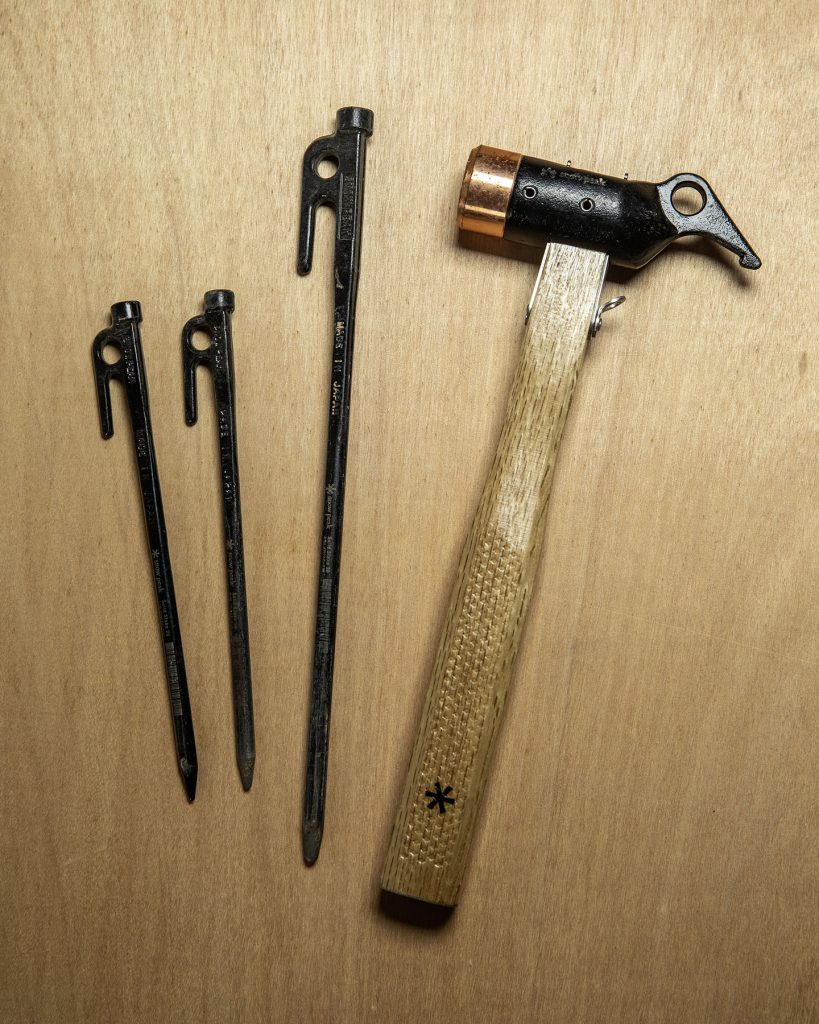
Out of all those, it has been years since I have used anything other than my Snow Peak forged steel tent stakes.
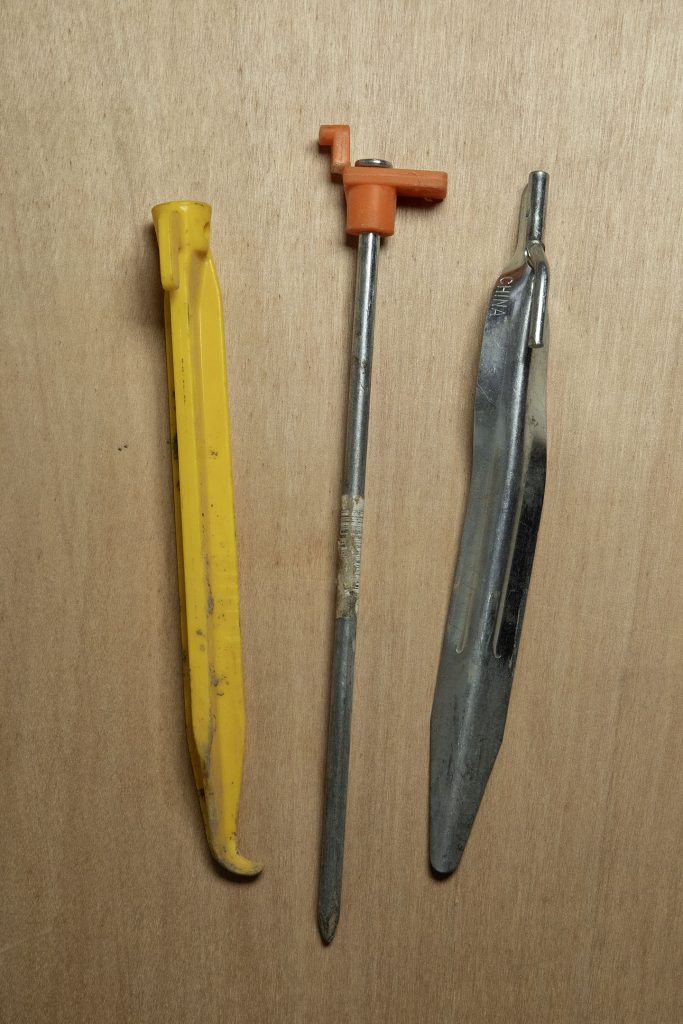
The yellow plastic tent stakes hold well if you can get them into the ground, but often you can’t, and then frequently they break, especially when you try to get them back out.
There are the big metal nails with plastic flanges. Those sound good in theory, but nowadays they are made of zinc-steel alloy that is very soft and bends easily. You’re not supposed to pull up on the flange to take them out, but then how else do you get them out?
The angle-iron stakes probably do well in sandy soil, but forget about using them anywhere near a rock, and even hard clay will cause them to bend.
I bought these because I always needed to replace broken stakes, and they were cheap. It seemed like I should have different kinds of stakes for different situations.
The first time I saw one of the Snow Peak forged steel stakes was at Cabela’s. It caught my eye because it was huge. The #50 stake is nearly 20 inches long, which is ridiculous, but they had smaller ones, too. I immediately admired the slender shape of them. I bought my first few in 2018, ahead of a camping road trip to Padre Island National Seashore, after bending a whole set of the “nail” stakes.
Something I didn’t know about Padre Island is that it is typically quite windy. I had brought a cabin style tent with near vertical walls. As the wind speed crept up above twenty and then thirty knots, I knew I better set up more guy lines. The soil was almost pure sand, but I only had a few of the MSR ToughStakes for sand. Out of desperation, I drove my four #30 Snow Peak stakes into the sand. Surprisingly, even though they are so slender, they held solidly in place. They didn’t move the whole night.
Over the years, the forged steel stakes have done the job after other stakes have failed. Here in the Ozarks, the ground is usually quite rocky. Many of the state parks spread gravel for tent pads. When it’s not rocky, dry clay can almost seem like rock. The Snow Peak stakes reliably go through it all. I don’t even bother with the other stakes anymore.
They have also been reliable out west. Loose, dry soil. Rocky or gravelly ground. Soft peat.
I have never bent or broken any of them, although I have blunted several of the points driving them through rocks. Rather than a disposable item, they are a lifetime investment. I currently have twelve of the #20 stakes and four of the #30 stakes.
I normally use the #20 stakes, but sometimes I will use a #30 stake when the ground is soft to secure something critical, such as the point of a large vestibule.
A couple years ago, I went and bought the copper head hammer. It really does feel nice driving the stakes in. It also has a hook that makes it very easy to pull the stakes up.
Anyway, I realized it was pointless for me to carry around all those other stakes I don’t use. They’re in the trash now.
I frequently drive or ride by a “park” on Baumgartner Rd. in Oakville, Missouri. There’s a sign out front, naming it St. Louis County Classe Park. There’s a crumbling asphalt drive that is gated, and as far as I can tell, there’s no other way in. What is it?
The St. Louis County Parks & Attractions page says nothing about it, except for a dot on the map, which reveals this information: “Undeveloped, Land Bank”. Property viewers show a small block of land. Aerial photos show that it is wooded, but there seems to be a small area of mowed grass.
The sign lists hours, so presumably it is open to the public. I could probably park my car in front of the gate. Or I could ride there.